General Discussion
Related: Editorials & Other Articles, Issue Forums, Alliance Forums, Region Forums
Lake Powell hits lowest summer level ever, raising risk of 'dead pool'
https://www.usatoday.com/story/news/nation/2026/06/25/why-lake-powell-risk-dead-pool/89557878007/Lake Powell hits lowest summer level ever, raising risk of 'dead pool'
Huge Colorado River reservoir straddles Utah-Arizona border
Trevor Hughes
Lake Powell ‒ the massive Colorado River reservoir that produces power for millions of homes across the West ‒ is the emptiest it has ever been entering the hottest part of the summer. And the worst is still to come.
Although the lake's levels have briefly fallen lower in years past, those low-water levels came in the spring, before melting snow refilled it. This year, that refill never happened.
As a result, Lake Powell will next spring fall to "minimum power pool," according to a newly released federal projection. If the water levels fall below that, the Glen Canyon Dam would stop generating electricity.
The amount of water in the reservoir has slowly been dropping as long-term climate change creates a warmer and drier West. Today, the lake is 23.28% full. It was last completely full in 1983.
Federal water managers have already been sucking water out of other reservoirs in Colorado and Wyoming to slow Lake Powell's decline. But their predictions also show Lake Powell's water level will nevertheless continue dropping until late next spring, when this coming winter's snow begins to melt.
...
 = new reply since forum marked as read
Highlight:
NoneDon't highlight anything
5 newestHighlight 5 most recent replies
= new reply since forum marked as read
Highlight:
NoneDon't highlight anything
5 newestHighlight 5 most recent replies

SalamanderSleeps
(1,065 posts)The Lake Powell Dam generates hydroelectric power for approximately 5.8 million households and businesses across seven states: Arizona, Colorado, Nebraska, Nevada, New Mexico, Utah, and Wyoming.
Everything's going to be alright.
They can just buy some extra water from Earth II.
Right?

hunter
(40,947 posts)It was a bad idea from the very start.
We've really got to stop pretending the Colorado River is ever going to be what it once was. If Glen Canyon Dam was removed any loss of power would be made up for by increased power production at Hoover Dam, assuming there's enough water for that.
The loss of reliable electric power from both of these dams has already been accounted for in the operation of Western power grids. When, inevitably, both dams fall below "minimum power pool" any increases in the price of electricity caused by that will be negligible.
I noted in a previous post that in recent years the Palo Verde nuclear plant is producing about ten times more electricity than Hoover Dam.
If future generations loose the industrial capacity to remove or maintain these dams the consequences will be catastrophic when these dams inevitably fail.
Unfortunately our society discounts entirely any death, destruction, or suffering we inflict on future generations. A large portion of our population doesn't even care about the children of today's world.
Response to hunter (Reply #2)
SamuelTheThird This message was self-deleted by its author.

31j20b3
(105 posts)that season started June 15th and it will go thru Labor Day.
With luck that will help the Colorado basin. While the traditional 'core' of the SW Monsoon season isn't north enough to help, the extension of the seasonal rains does include Colorado, and Utah. So with some luck, there will be good water flow into the watersheds that serve Lake Powell

maxsolomon
(39,430 posts)I had the pleasure (mostly) of rafting the San Juan above the lake's slack water 10 years ago.
The amount of silt built up on the riverbed turned the last few miles before the Clay Hills takeout into a miserable experience - wading through mucky silt pulling the raft into a fierce headwind, rocking it over sand bars. That silt isn't going anywhere for generations.
Lake Powell was a serious miscalculation.

A HERETIC I AM
(24,912 posts)I took this picture on my 1996 trip of Rainbow Bridge National Monument. The lake was only a couple of feet below “full pool“
The boat dock was only about 40 yards behind me, so you could bring a full length houseboat all the way up the canyon to within sight of the bridge.
Now it’s more than a mile hike up the canyon.
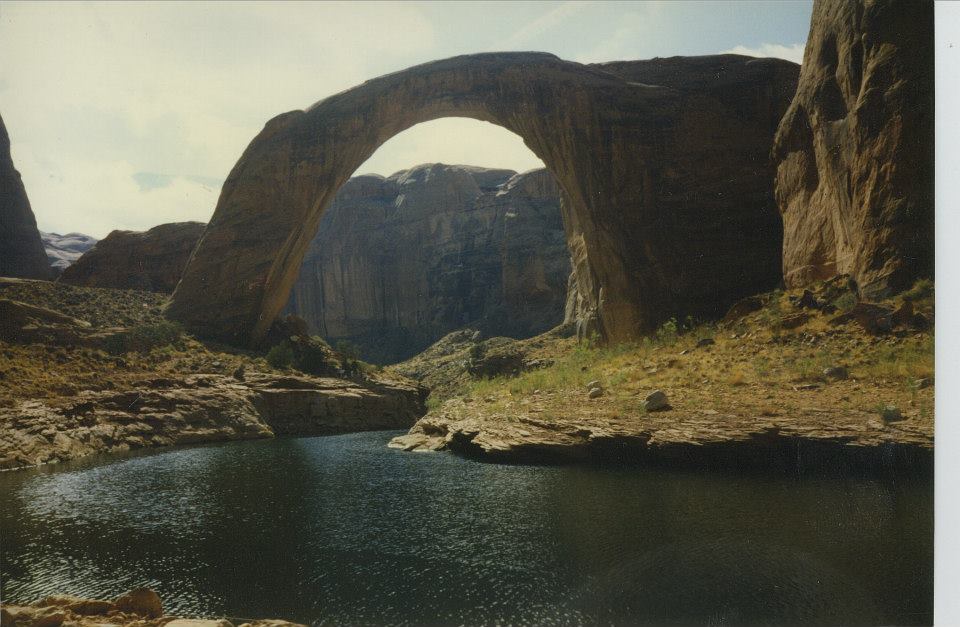
When the dam was completed in the early 60s, it took 20 years for the lake to get to full pool.
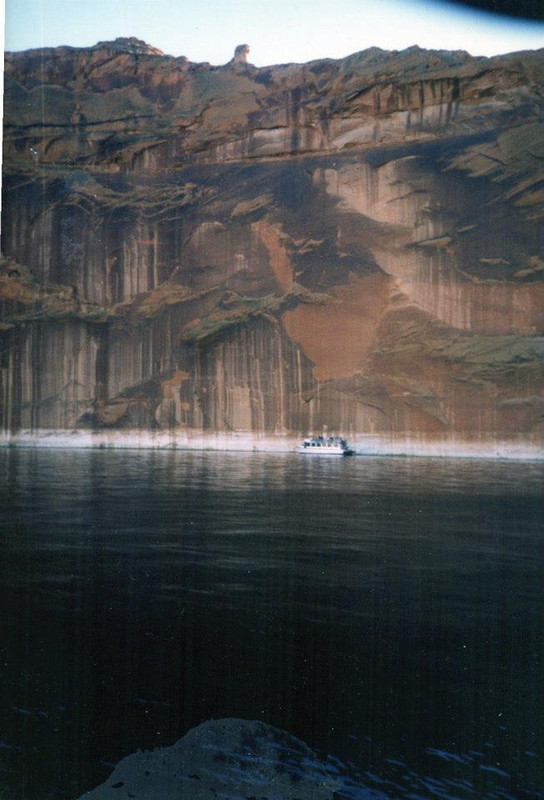
This shot below was taken a year later on my return to the lake in 1997. This was October, as I was on the lake during Halloween. The boat in the picture is about 60 feet long and it is one of the numerous tour boats that will take sightseers out to various spots on the lake. This particular area is on Navajo Canyon on the southern end of the lake where there is a dramatic canyon wall that goes straight up.
You can clearly see the so-called “bathtub ring”, so the lake had dropped almost 20 feet over the course of the preceeding 12 months. The water level is 150 feet below that spot now.
This was near the beginning of the gradual drop in average water level that has gotten the lake to where it is today
The current situation was entirely predictable based on the minimal snowpack experienced in the upper Colorado basin last winter. If you follow Weather news, you may recall that many of the major ski areas delayed their 2025/26 season openings because of the lack of snow in November and December. The Colorado snow pack in particular was something like 50% of normal if I remember correctly.
It’s not just the electricity generated by the Glen Canyon Dam either, but the agriculture that relies on the Colorado river. If you look at Google maps and switch to the satellite shots, you can see the green agriculture areas all along the river downstream of Lake Mead. There’s also a major aqueduct that pulls water out of the Colorado, pumps it over the mountains into the LA basin.
This does not bode well for millions and millions of people.
hunter
(40,947 posts)People living in cities can afford expensive water, farms can't.
Cities like Phoenix will pay Southern California's coastal regions for desalination plants and toilet-to-tap water sewage recycling projects in exchange for Southern California's share of the Colorado River. That's already starting to happen.
If things continue to get worse it's feasible to directly transfer desalinated water for urban uses to cities in the Lower Colorado River Basin. Heat, not water, will be the biggest problem in those cities. If the power goes out people will die.
The people in the Upper Colorado Basin are out of luck if things get really, really bad. Once they've abandoned outdoor irrigated landscaping, agriculture, and water-intensive industries, urban water rationing could become severe.

RT Atlanta
(2,872 posts)Oh, and quick fucking constructing water-sucking data centers in Arizona......