Welcome to DU!
The truly grassroots left-of-center political community where regular people, not algorithms, drive the discussions and set the standards.
Join the community:
Create a free account
Support DU (and get rid of ads!):
Become a Star Member
Latest Breaking News
Editorials & Other Articles
General Discussion
The DU Lounge
All Forums
Issue Forums
Culture Forums
Alliance Forums
Region Forums
Support Forums
Help & Search

Sweetness and strangeness

In our image-saturated, over-sped world, we are losing the imaginative power to create and find meaning through metaphor
https://aeon.co/essays/metaphors-grow-the-mind-and-feed-the-soul-dont-lose-them

This April, Forbes magazine published the article ‘The Writer Who Couldn’t Answer Standardized Test Questions About Her Own Work (Again)!’ It focused on the American poet Sara Holbrook, who had written for the Huffington Post about just this dilemma – her evident inexpertise about her own poetry – and who was thrust into the spotlight once more, after discovering that one of her most straightforward poems had generated eight multiple-choice questions for high-school students. A number of teachers, frustrated by their own inability to choose the ‘correct’ answers, wrote to Holbrook, asking for her help discerning stanzas in the poor formatting, and quizzing her about the ‘best reason’ for a simile she chose to use. ‘Forget joy of language and the fun of discovery in poetry,’ Holbrook commented, reflecting on the episode: ‘This is line-by-line dissection, painful and delivered without anaesthetic.’
This sort of literal, invasive dissection of poetry is par for the course in contemporary education. In our experience (Heather teaches poetry to undergraduates), a semester might open with Rainer Maria Rilke’s ‘First Elegy’ (1923), which we read, then listen to aloud in both German and English. I ask the students to share what they do when they first encounter a new poem. My hopes – that they will hear the sound of the music, be struck by images, be intrigued by the movement of ideas, and bewildered by Rilke’s comparison of beauty to terror – generally get dashed, as I look out at a roomful of perplexed expressions. Finally, some brave soul will say something, always the same thing: Well, we break the text down. Into its parts. There is agreement from the rest, palpable relief. What else would you do with a poem, but approach it as one might approach the dissection of a frog or the separation of platelets in a Petri dish?
It is at this point that the most studious among them will remember the useful acronym they learned in school, the magic formula meant to crack the mystical world of text: soapstone. Although I’d spent years earning an MFA in Poetry and teaching with organisations such as the Teachers and Writers Collaborative, and California Poets in the Schools, I had never encountered this word. SOAPSTone, as my students explained, is an acronym for ‘Speaker, Occasion, Audience, Purpose, Subject and Tone’. This conceptual architecture is commonly taught as a way of looking not only at technical texts and expository writing but as the clearest way to interpret every kind of text, from the literal to the metaphoric. The purpose of SOAPSToning can be gleaned from a statement on the Advanced Placement Test website:
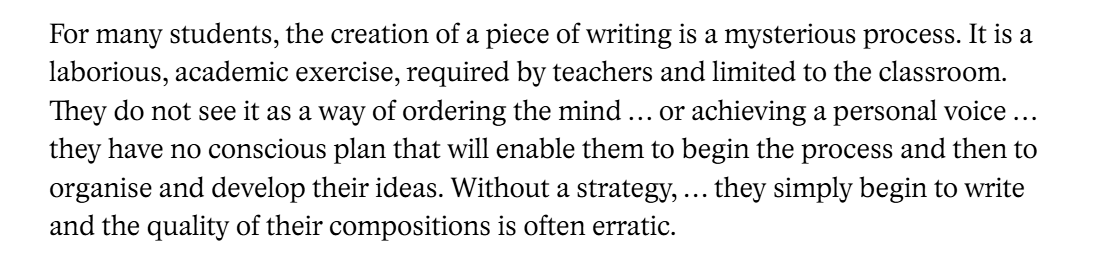
To utilise SOAPSTone is to look at a model poem or essay, dissect it, and then respond to a prompt to write a composition of one’s own. The website acknowledges that the strategy ‘may appear to be somewhat formulaic and rigid, but it helps students, especially novice writers, clarify and organise their thoughts’. The strategy is formulaic and rigid. We – as a writer and a mythographer – might not object to that, if students themselves understood it as an aid for novice writers and readers; that is, a way of approaching a poem as a stage you pass through on your way to becoming a reader of poetry – the sort of person who actually enjoys poetry, rarely if ever pausing to explicitly consider ‘purpose’ or ‘occasion’. But for these students, SOAPSTone is, to paraphrase John Keats, all they know about reading poetry, and all (they have been led to believe) they need to know. Or rather, what they need to know to pass the standardised tests, the be-all and end-all of modern education.
snip
1 replies
 = new reply since forum marked as read
Highlight:
NoneDon't highlight anything
5 newestHighlight 5 most recent replies
= new reply since forum marked as read
Highlight:
NoneDon't highlight anything
5 newestHighlight 5 most recent replies
= new reply since forum marked as read
Highlight:
NoneDon't highlight anything
5 newestHighlight 5 most recent replies
Sweetness and strangeness (Original Post)
Celerity
Jan 12
OP

CTyankee
(68,015 posts)1. I had a writing class in grad school that did just this. We read certain poems and wrote our own.
read the poetry aloud to the class. The first class was held on the day after 9/11 and we wrote about that. Then we each read our "work" aloud to the rest of the class.