Environment & Energy
Related: About this forumAll Together Now! Microplastic Pollution, Ocean Acidification, Halogenated Methanes, Ozone Collapse... Delicious!
Last edited Sun Jun 29, 2025, 09:24 AM - Edit history (1)
Here's a charming paper I came across this morning: Decreased Dimethylsulfide and Increased Polybrominated Methanes: Potential Climate Effects of Microplastic Pollution in Acidified Ocean Qian-Yao Ma, Ya-Wen Zou, Jun-Qi Yang, and Gui-Peng Yang Environmental Science & Technology 2025 59 (24), 12145-12157.
Synergies, you have to love them.
From the text:
Dimethylsulfide (DMS) is the most abundant volatile biogenic sulfur compound in the ocean, contributing a sea-to-air flux of 27.1 Tg S per year and accounting for 50% to 80% of marine sulfur emissions. (10) Atmospheric mixing ratios of DMS in marine environments typically range from tens to hundreds of parts per trillion (pptv), which is approximately 3 orders of magnitude lower than its concentration in seawater (nmol L–1). (11) Once emitted into the atmosphere, DMS undergoes rapid reactions with radicals, resulting in an atmospheric lifetime of approximately 1 to 2 days. The oxidation products of DMS play a crucial role in both the growth of existing aerosol particles and the formation of new particles, ultimately giving rise to nonsea-salt sulfate (nss-SO42–) aerosols. (12) These aerosols can directly scatter solar radiation or indirectly enhance the abundance of cloud condensation nuclei, thereby influencing cloud microphysical properties and modifying the global radiation budget. (13) The radiative forcing of DMS-derived aerosols is estimated to range from −1.7 to −2.3 W m–2, (14,15) a magnitude comparable to the positive radiative forcing from anthropogenic CO2 emissions (1.83 ± 0.2 W m–2). (16) Notably, short-lived polybrominated methane compounds, specifically bromoform (CHBr3) and dibromomethane (CH2Br2), serve as the main sources of bromine radicals in the atmosphere, which could contribute up to 30% of the DMS oxidation in the open sea. (17) Moreover, bromine radicals arising from CHBr3 and CH2Br2 could reduce the number of cloud condensation nuclei derived from DMS by decreasing the conversion efficiency of DMS to SO2 or shortening the lifetime of DMS, thereby weakening the climate-cooling effect of DMS. (18) The climate-active atmospheric DMS, CHBr3, and CH2Br2 are primarily emitted from marine sources, with production largely by phytoplankton and bacteria in the euphotic zone. (19) MP pollution and OA have been shown to impact the growth, community structure, and physiological behaviors of marine microbes, thereby altering the biogeochemical cycles of key elements in the ocean. (20,21) However, the influence of MP in future acidified marine environments on the production of climate-active gases like DMS, CHBr3, and CH2Br2 has not been explored, limiting our understanding of the potential climate impacts of MP pollution.
MP is recognized as a stressor for phytoplankton, with its physical collisions, shading effects, and leachates impacting the abundance and community structure of phytoplankton. (22) Additionally, OA exerts negative effects on physiological processes in phytoplankton, such as calcification and extracellular enzyme activity, particularly when combined with other environmental stressors. (23) Phytoplankton represent the major source of dimethylsulfoniopropionate (DMSP) and its cleavage product DMS in marine systems, (24) and thus the combined inhibitory impacts of MP and OA on phytoplankton physiology are expected to inhibit DMS production. The primary biogenic production pathway of polybrominated methane involves the reaction of bromoperoxidase (BrPO) with bromide ions in the presence of hydrogen peroxide (H2O2), yielding hypobromous acid (HOBr), which then reacts with dissolved organic matter (DOM) to form unstable intermediates that decompose into polybrominated methane. (25) Studies indicate that MP can leach DOM or increase the production and release of DOM by phytoplankton, (26,27) which serves as a substrate for the production of polybrominated methane. Since BrPO exhibits optimal activity at approximately pH 6.5, (28) the shift toward lower pH under OA could enhance BrPO-mediated bromination. Thus, both MP pollution and OA could potentially increase the production of polybrominated methane. Based on these insights, we hypothesize that MP pollution in future acidified marine environments could inhibit DMS production and enhance the production of CHBr3 and CH2Br2, thereby weakening the climatic cooling effect of DMS...
A cartoon about the overall effects:
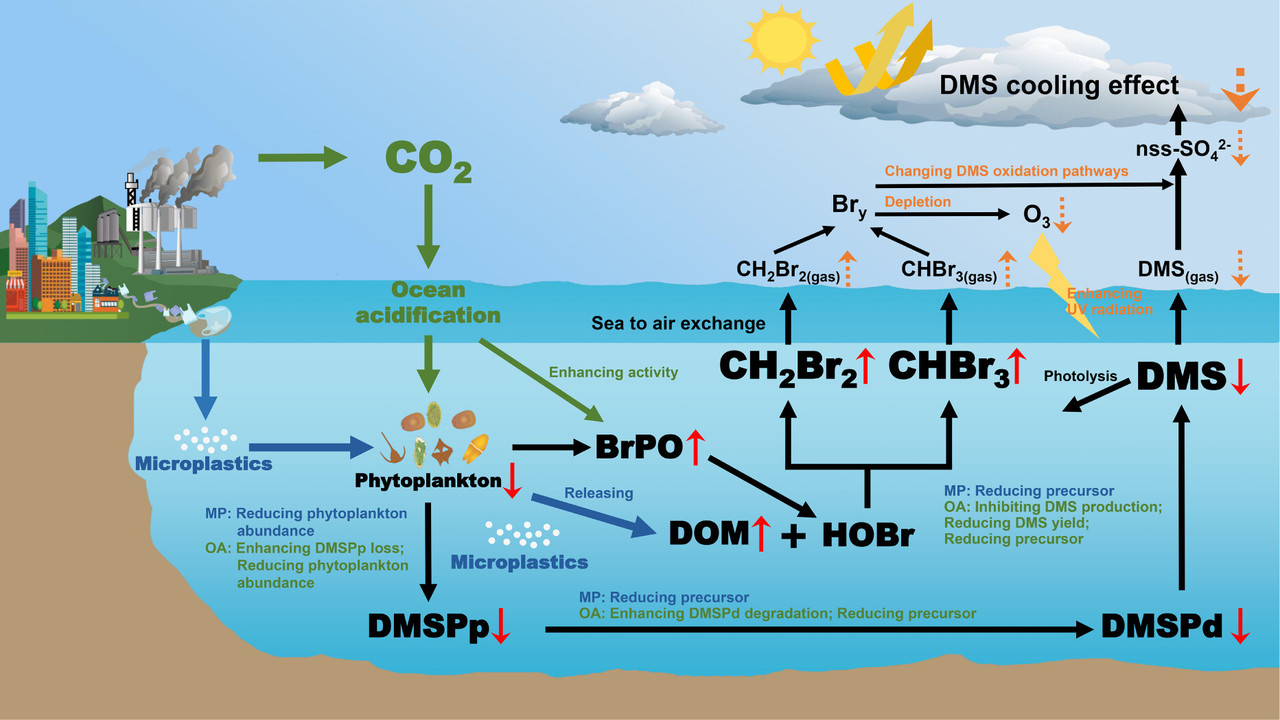
The caption:
Some additional fun text:
While we are distracted by the accelerating fall of the United States in an orgy of anti-intellectualism, the planet as a whole is undergoing rapid decay.
 = new reply since forum marked as read
Highlight:
NoneDon't highlight anything
5 newestHighlight 5 most recent replies
= new reply since forum marked as read
Highlight:
NoneDon't highlight anything
5 newestHighlight 5 most recent replies


speak easy
(12,598 posts)New results show with high statistical confidence that ozone recovery is going strong.
March 5, 2025 - https://news.mit.edu/2025/study-healing-ozone-hole-global-reduction-cfcs-0305

NNadir
(38,553 posts)It is here: Wang, P., Solomon, S., Santer, B.D. et al. Fingerprinting the recovery of Antarctic ozone. Nature 639, 646–651 (2025).
From the text:
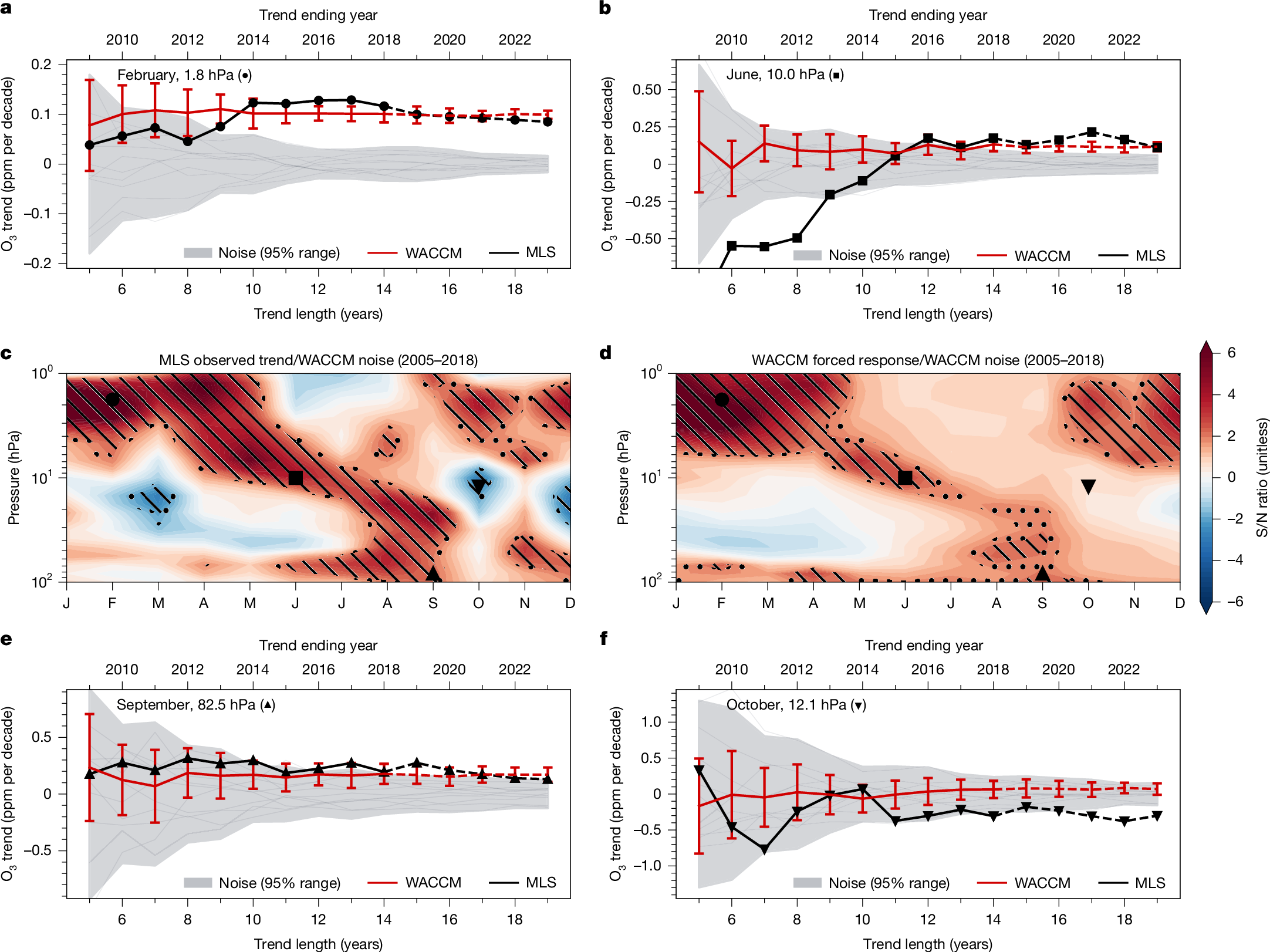
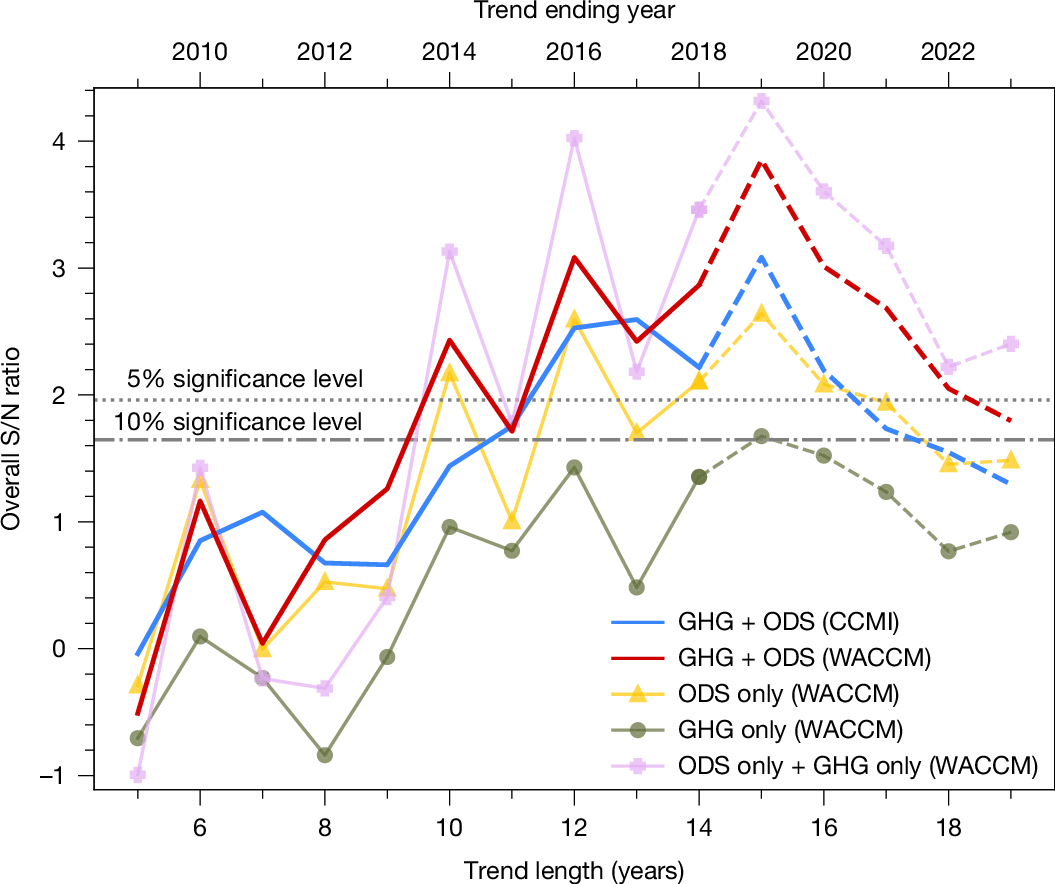
Initial-condition large ensembles (LEs) generated with fully coupled global climate models offer a unique opportunity to ‘fingerprint’ the anthropogenic influence. They provide valuable information on both natural internal variability and the characteristic space and time signatures of the climate responses to different external forcings5,6,7,8,9,10,11,12. Such ensembles are rarely used in ozone studies, which generally apply multiple linear regression to isolate underlying forced trends by fitting ozone time series to known sources of variability (such as the solar cycle, El Niño–Southern Oscillation, quasi-biennial oscillation, volcanic activities etc.)4,21. By contrast, LEs do not require the assumption that the response is a linear combination of independent predictor variables22. Although some D&A methods have been applied to global ozone depletion and the time of emergence of total column recovery using multi-model ensembles23,24,25, previous studies have not fully used the pattern-based D&A techniques. Furthermore, several members from a single model that is well evaluated and realistic can reliably quantify modelled forced signals and intrinsic variability, whereas one run from each of a multi-model ensemble samples larger cross-model differences in forcing, response and variability26, thus hampering the identification of the beginning of ozone recovery23,24....
Figures from the text:
 ?as=webp
The caption:
 ?as=webp
The question that needs to be asked is whether the rate of a presumed "recovery" will slow as bromination described in the paper grows to match the issue that arose with manufactured CFCs.
Hopefully you are correct but I'm not sure that what is described in the OP may overwhelm the current trend.

eppur_se_muova
(42,524 posts)OK, I guess it's for making all those weird brominated marine metabolites, but still .... was there really that much selection pressure for such a thing ? 

highplainsdem
(63,112 posts)
Kick in to the DU tip jar?
This week we're running a special pop-up mini fund drive. From Monday through Friday we're going ad-free for all registered members, and we're asking you to kick in to the DU tip jar to support the site and keep us financially healthy.
As a bonus, making a contribution will allow you to leave kudos for another DU member, and at the end of the week we'll recognize the DUers who you think make this community great.