Welcome to DU!
The truly grassroots left-of-center political community where regular people, not algorithms, drive the discussions and set the standards.
Join the community:
Create a free account
Support DU (and get rid of ads!):
Become a Star Member
Latest Breaking News
Editorials & Other Articles
General Discussion
The DU Lounge
All Forums
Issue Forums
Culture Forums
Alliance Forums
Region Forums
Support Forums
Help & Search
Environment & Energy
Related: About this forum
The Imminent Copper Tailings Crisis in China
The paper I'll briefly discuss in this post is this one: The Imminent Copper Tailings Crisis in China Dongfang Guo, Huimin Hou, He Liu, and He Xu Environmental Science & Technology 2026 60 (2), 1800-1809.
I have discussed the limits of meeting copper demand here previously:
Copper Cannot Be Mined Fast Enough to "Electrify Everything," Not Even Cars.
One of the slogans I often repeat in my posts here is this one:
History will not forgive us, nor should it.
(This statement is contingent of the belief that honest historians will still exist in the post reason age.)
One of the supporting arguments for the statement is to note that besides leaving a destroyed atmosphere, polluted land and dying seas we have robbed future generations of all the best ores leaving behind only low grade ores and perhaps minable landfills. The cited article touches on this point.
From the introductory text:
The mining industry has long been a vital driver of economic growth, providing essential primary resources for societal development. (1,2) However, mining operations also generate substantial amounts of waste, with tailings, which are fine-grained residues left after the extraction of valuable minerals, representing the largest stream of solid waste in the sector. (3) Tailings are typically stored in tailings storage facilities (TSFs), but large-scale, centralized storage poses significant risks to ecosystems, human health, and environmental safety across downstream areas. (4−6) In pursuit of profitability, mining companies traditionally focus on high-grade ore bodies. However, as these high-quality deposits become increasingly scarce, the industry is shifting toward the exploitation of lower-grade ores. To maintain equivalent metal output from these ores, more raw material must be processed, and to preserve economic viability, companies often expand production, which in turn results in a continuous rise in tailings generation. (7)
Copper, a key metal in modern industrial systems, is extensively used in power infrastructure, construction, transportation, electronics, and more. (8,9) Global demand for copper continues to grow, and its strategic importance has become even more pronounced in the context of the global energy transition. (10−14) For instance, electric vehicles require approximately 2.5 to 4 times more copper than conventional internal combustion engine vehicles. (15) Similarly, renewable energy systems utilize more than twice the amount of copper per unit of power output compared to traditional thermal power plants, mainly in components such as heat exchangers, turbines, and transformers. (16) China possesses a comprehensive copper industry chain and ranks among the world’s leading copper producers. (17) However, its resource base is characterized by low-grade and associated ores, particularly widely distributed porphyry copper deposits with significantly lower ore grades than those found in major copper-producing countries like Peru and Chile. (18) Consequently, China generates more tailings per ton of refined copper. To further mitigate global climate change, China launched the “dual-carbon” policy in 2020, aiming to peak carbon emissions by 2030 and achieve carbon neutrality by 2060. (19) This policy is expected to drive a substantial increase in copper demand. (20−23) Coupled with the China accelerating “Zero-Waste city” initiatives, managing tailings generation has consequently emerged as a critical environmental challenge. Although the Chinese government has introduced several policy measures to enhance the safety of TSFs and prevent catastrophic failures, (23,24) deficiencies persist in the statistical systems related to tailings. This includes the lack of historical data sets, spatial distribution analyses, and forward-looking forecasts, all of which hinder scientific management and evidence-based policymaking.
Material flow analysis (MFA) is a well-established methodology that has been extensively applied to metals such as iron, aluminum, copper, lithium, cobalt, and rare earth elements. (25−31) These studies typically examine material flows and stock dynamics over the life cycle within a defined geographical context to support sustainable resource management. However, research focusing specifically on tailings remains limited. While some industrial metabolism studies consider the mining and beneficiation stages, tailings are often treated simplistically as waste or latent resources, (32) lacking comprehensive analysis of their spatial-temporal dynamics and environmental pressures. Although the Total Material Requirement (TMR) indicator in MFA can reflect a resource’s material footprint to some extent, (33−36) inconsistencies in coefficient selection often lead to significant variation in results. Furthermore, as a comprehensive indicator that typically includes other types of waste such as waste rock in addition to tailings, (37,38) TMR lacks sufficient granularity to support targeted tailings management strategies.
Given these gaps, this study develops a geographically resolved model to quantify copper tailings, trace their historical evolution since 1950 in China’s key copper-producing provinces, and identify major generation hotspots. We apply a dynamic material flow analysis framework to forecast future trends in tailings generation under China’s “dual carbon” policy and to examine the effects of circular economy practices and international trade on tailings storage. In addition, we use the USEtox model, a consensus-based tool for life cycle impact assessment, to evaluate the freshwater ecotoxicity resulting from tailings storage under various scenarios and to identify the critical affected areas...
Copper, a key metal in modern industrial systems, is extensively used in power infrastructure, construction, transportation, electronics, and more. (8,9) Global demand for copper continues to grow, and its strategic importance has become even more pronounced in the context of the global energy transition. (10−14) For instance, electric vehicles require approximately 2.5 to 4 times more copper than conventional internal combustion engine vehicles. (15) Similarly, renewable energy systems utilize more than twice the amount of copper per unit of power output compared to traditional thermal power plants, mainly in components such as heat exchangers, turbines, and transformers. (16) China possesses a comprehensive copper industry chain and ranks among the world’s leading copper producers. (17) However, its resource base is characterized by low-grade and associated ores, particularly widely distributed porphyry copper deposits with significantly lower ore grades than those found in major copper-producing countries like Peru and Chile. (18) Consequently, China generates more tailings per ton of refined copper. To further mitigate global climate change, China launched the “dual-carbon” policy in 2020, aiming to peak carbon emissions by 2030 and achieve carbon neutrality by 2060. (19) This policy is expected to drive a substantial increase in copper demand. (20−23) Coupled with the China accelerating “Zero-Waste city” initiatives, managing tailings generation has consequently emerged as a critical environmental challenge. Although the Chinese government has introduced several policy measures to enhance the safety of TSFs and prevent catastrophic failures, (23,24) deficiencies persist in the statistical systems related to tailings. This includes the lack of historical data sets, spatial distribution analyses, and forward-looking forecasts, all of which hinder scientific management and evidence-based policymaking.
Material flow analysis (MFA) is a well-established methodology that has been extensively applied to metals such as iron, aluminum, copper, lithium, cobalt, and rare earth elements. (25−31) These studies typically examine material flows and stock dynamics over the life cycle within a defined geographical context to support sustainable resource management. However, research focusing specifically on tailings remains limited. While some industrial metabolism studies consider the mining and beneficiation stages, tailings are often treated simplistically as waste or latent resources, (32) lacking comprehensive analysis of their spatial-temporal dynamics and environmental pressures. Although the Total Material Requirement (TMR) indicator in MFA can reflect a resource’s material footprint to some extent, (33−36) inconsistencies in coefficient selection often lead to significant variation in results. Furthermore, as a comprehensive indicator that typically includes other types of waste such as waste rock in addition to tailings, (37,38) TMR lacks sufficient granularity to support targeted tailings management strategies.
Given these gaps, this study develops a geographically resolved model to quantify copper tailings, trace their historical evolution since 1950 in China’s key copper-producing provinces, and identify major generation hotspots. We apply a dynamic material flow analysis framework to forecast future trends in tailings generation under China’s “dual carbon” policy and to examine the effects of circular economy practices and international trade on tailings storage. In addition, we use the USEtox model, a consensus-based tool for life cycle impact assessment, to evaluate the freshwater ecotoxicity resulting from tailings storage under various scenarios and to identify the critical affected areas...
I added the bold.
Some graphics from the paper:
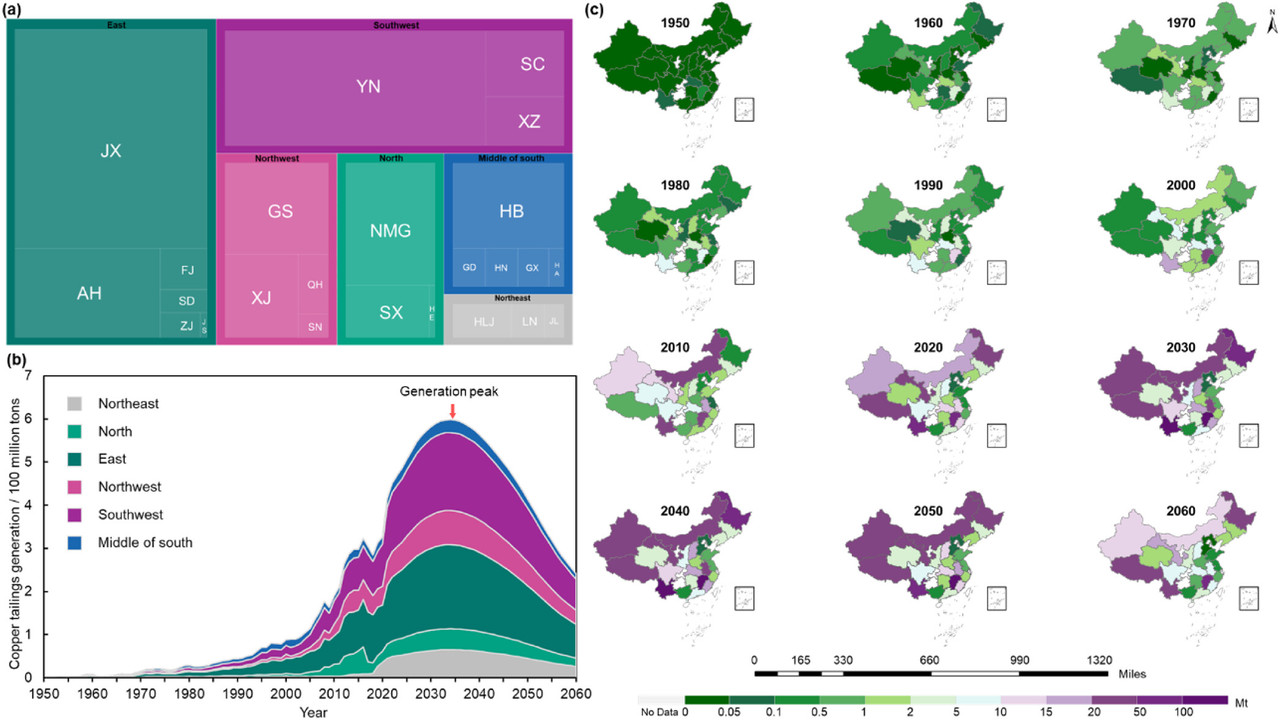
The caption:
Figure 2. Copper tailings generation in China. (a) Cumulative regional contributions to copper tailings generation, 1950–2020; (b) Trends in copper tailings generation in China, 1950–2060; (c) Provincial distribution of copper tailings in China.
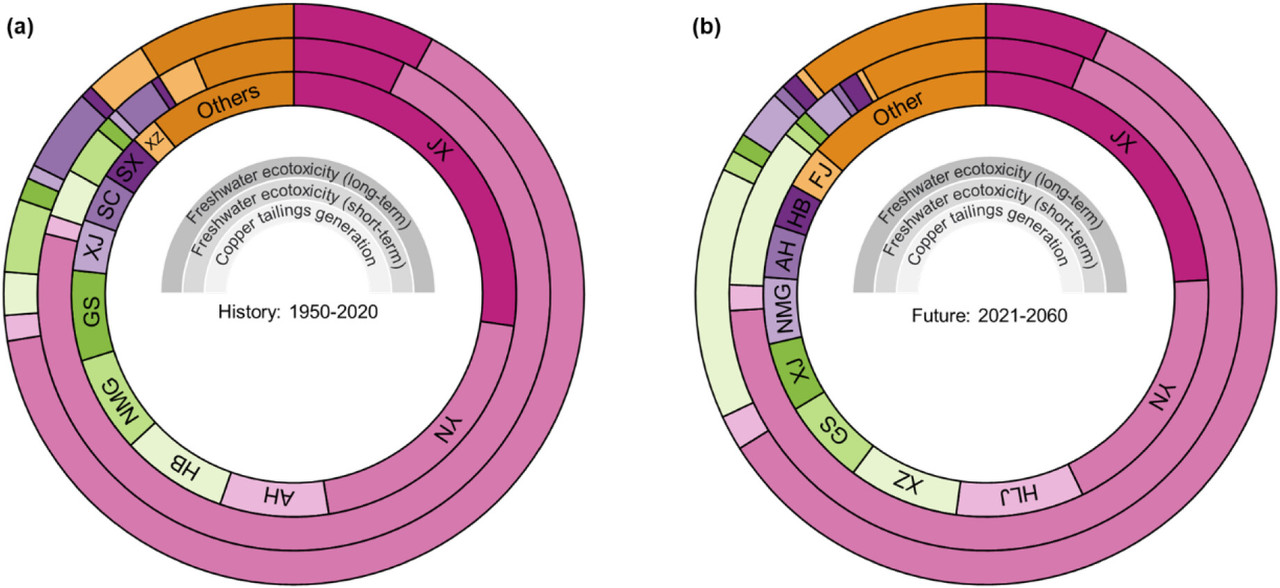
The caption:
Figure 3. Freshwater ecotoxicity impacts from copper tailings storage in China. (a) Provincial contributions to the ecotoxicity of historical copper tailings (1950–2020); (b) Provincial contributions to the ecotoxicity of projected copper tailings (2021–2060).
From the section on policy implications (TSF, defined above is "Tailings Storage Facilities, i.e. dumps):
Achieving China’s “dual carbon” goals presents substantial challenges for copper tailings management, particularly in the context of constructing “Zero-Waste city”. Our forecasts indicate that under a carbon neutrality pathway, copper tailings generation is expected to increase significantly, thereby exacerbating disposal pressures and ecological risks. Historically, more than 100 TSFs incidents have been recorded in China since 1950. (53) In recent years, incidents such as the Lufeng TSF collapse in Yunnan and the tailings leakage at the Luming Mine in Heilongjiang have raised widespread public concern (54,55) and underscored the urgency of more sustainable tailings governance. In response, the Chinese government has issued the Work Plan for Preventing and Defusing Safety Risks of Tailings Storage Facilities, (23) which stipulates that starting in 2020, the number of TSFs nationwide should “only decrease, not increase,” except for strategic and scarce mineral development. Against the backdrop of increasingly stringent regulations on the construction of new TSFs, our field research suggests that existing TSFs in key copper-producing regions such as Yunnan and Anhui have less than a decade of remaining storage capacity, highlighting the unsustainability of traditional end-of-pipe disposal models. A transition away from storage-centric tailings management is urgently needed. Promoting tailings resource utilization can not only effectively consume accumulated tailings but also alleviate resource pressures by replacing natural materials such as sand and concrete aggregates, (56) while simultaneously delivering significant environmental benefits. (57−59)
The authors note that the tailings may be subject to use, perhaps to extract residual metals, but this of course, involves energy requirements, although the authors claim that the energy calculations could be beneficial.
Nevertheless, to beat another of my dead or dying horses, a requirement for mining to support so called "renewable energy" calls into question whether the word "renewable" is actually applied to the subject in a valid and supportable way.
I trust you're having a pleasant weekend.
1 replies
 = new reply since forum marked as read
Highlight:
NoneDon't highlight anything
5 newestHighlight 5 most recent replies
= new reply since forum marked as read
Highlight:
NoneDon't highlight anything
5 newestHighlight 5 most recent replies
= new reply since forum marked as read
Highlight:
NoneDon't highlight anything
5 newestHighlight 5 most recent replies
The Imminent Copper Tailings Crisis in China (Original Post)
NNadir
Jan 2026
OP

littlemissmartypants
(36,088 posts)1. Thanks.
