Environment & Energy
Related: About this forumMaking hydrogen fuel cells 'less precious'
https://source.washu.edu/2026/02/making-hydrogen-fuel-cells-less-precious/By Leah Shaffer February 6, 2026
…
In research published in Nature Catalysis, Wu and his team outlined how they stabilize iron catalysts for use in the fuel cell, which would lower costs for fuel-cell vehicles and other niche applications such as low-altitude aviation and artificial intelligence data centers.
…
Unlike electric battery-run cars, people can’t recharge fuel-cell vehicles using their home electricity sources. So there needs to be affordable and easily accessible hydrogen refueling infrastructure for this clean tech to take off. Making use of plentiful and affordable iron catalysts would go a long way to lowering those costs. But first, researchers needed to make iron more stable to handle the fuel-cell chemistry involved.
Wu and his team did so by creating a chemical vapor of gases that can stabilize the iron catalysts during thermal activation, an innovative approach to significantly improve catalyst stability while maintaining adequate activity in proton exchange membrane fuel cells (PEMFCs). The result vastly improved iron catalysts’ durability along with increased energy density and life span. The team chose PEMFCs among different fuel types because they best serve heavy-duty vehicles, things like transport trucks, buses and construction equipment — vehicles that already go to centralized fueling centers. It’s most affordable and efficient for the technology to be first adopted by heavy-duty vehicle fleets, which would further lower costs as it becomes widespread and further efficiencies of scale come on board.
“After suffering from the poor stability for decades, now we were able to address the critical problem,” said Wu, who explained that next steps will include further refining their processes to make iron catalysts even better than precious metals for the fuel cells of tomorrow.
…
 = new reply since forum marked as read
Highlight:
NoneDon't highlight anything
5 newestHighlight 5 most recent replies
= new reply since forum marked as read
Highlight:
NoneDon't highlight anything
5 newestHighlight 5 most recent replies

NNadir
(38,974 posts)...sustainable.
If one searches Google scholar, with the search terms, hydrogen, electrocatalyst, "platinum free" one will come up with close to 4000 hits, 484 of which have been published since the beginning of 2025, 62 in 2026.
There are no papers published anywhere, however, that can overturn the laws of thermodynamics - one of which, the 2nd, means that storing energy wastes energy.
The "energy storage is green crap" is handed out by people who haven't noticed that the trillions of dollars squandered on so called "renewable energy" has had no environmental benefit, that the the only result of tearing the shit out of the planet for mines, destroying pristine wilderness for solar and wind industrial parks has had no other effect than making the collapse of the planetary atmosphere occur accelerate faster. Both the second derivative and even the third derivative of the experimentally determined rate of accumulation of the dangerous fossil fuel waste carbon dioxide are positive.
It's an ignorant affectation to hype energy storage, particularly as an industrially problematic gas, hydrogen, which has the 3rd lowest critical temperature of all known gases, the others being 4He and the decay product of tritium, 3He.
The real purpose of hydrogen hype is to greenwash dangerous fossil fuels.
The Journal of Hydrogen Energy published its first issue in 1976:
International Journal of Hydrogen Energy
Hydrogen was a bad idea in 1976, 1986, 1996, 2006, 2016, and remains one in 2026.
Have a nice day tomorrow.

OKIsItJustMe
(22,500 posts)More affordable catalysts will make “green hydrogen" more affordable. Among other things, “green hydrogen” can be used to make “green ammonia” for fertilizer (rather than producing it using the Haber-Bosch process.)
At this point roughly half of the world’s population depends on food grown using fertilizer produced using the Haber-Bosch process.;
https://www.weforum.org/stories/2023/11/green-ammonia-climate-change-energy-transition/

NNadir
(38,974 posts)The assholes in Germany, had to close their hydrogen plants because they could no longer buy dangerous natural gas from that bastard Putin whose war they financed.
I wrote not so long ago, with something called "references" about what hydrogen hype is all about:
A Giant Climate Lie: When they're selling hydrogen, what they're really selling is fossil fuels.
I certainly am well aware that antinukes run around all the time advocating for tearing the shit out of the planet, digging up the last best ores, converting huge stretches of land for industrial parks for wind and solar crap that will be lucky to last 25 years before becoming landfill. I attribute the rising rates of the collapse of the planetary atmosphere to this affectation.
Very clearly the people calling for this hold all future generations in extreme contempt.
They show up here often, although we haven't seen the fossil fuel marketeer with all the slick videos rebranding his, her or their product as "hydrogen," much recently.
It doesn't matter.
The hype for making this crap even worse by claiming that wasting energy to make hydrogen makes it all that much more obscene.
It is true that the world food supply depends on the Haber Bosch process. Since almost no hydrogen is made on a meaningful scale by electrolysis, and where it is, the electricity largely comes, as it does all over the world, from the combustion of dangerous fossil fuels (about which antinukes couldn't give a rat's ass), the Haber Bosch process is overwhelming dependent on dangerous fossil fuels. Fertilizer use for agriculture in one of many issues that drive the collapse of the planetary atmosphere.
There are many known thermochemical hydrogen cycles, accessible regrettably, only by using high temperatures. Their development has been problematic and challenging which is not a reason to stop working on them. As reported by Vaclav Smil in his still worthy to read book, Enriching the Earth (2000), the development of the Haber Bosch process was essentially a problem in materials science engineering, the role the chemical engineer Bosch played in industrializing Haber's lab based science. (The Haber Bosch process requires heat to run.)
Thermochemical hydrogen cycles are also materials science problems; the chemistry is well known. In fact, high temperature nuclear reactors, which are the only sustainable means of producing industrial heat, are materials science problems as well. I am proud to say, my son is involved in working to solve these problems, rather than piddling around with people who like to gloat about how their ignorance prevented nuclear energy from doing what it might have done, happily chanting that it is too late for nuclear to save what might have been saved and restore what is subject to restoration.
This insipid gloating disgusts me.
As for now, it is a profound thermodynamic issue that makes electrolysis to produce hydrogen a terrible idea, a frankly appalling idea, not that this reality, remaining intractable for many decades since the first industrialization of the Haber Bosch process more than 110 years ago, is likely to make people stop carrying on with "green hydrogen" bullshit. Electricity by its very nature is a thermodynamically degraded form of energy, and other than in lightening, is not a primary energy source on this planet.
Hydrogen, whether produced directly from fossil fuels, or indirectly by combusting fossil fuels to generate electricity, is a dirty commodity, since it requires largely dirty energy to make it. Half a century of "green hydrogen" bullshit handed out to the contrary has not changed this reality.
OKIsItJustMe
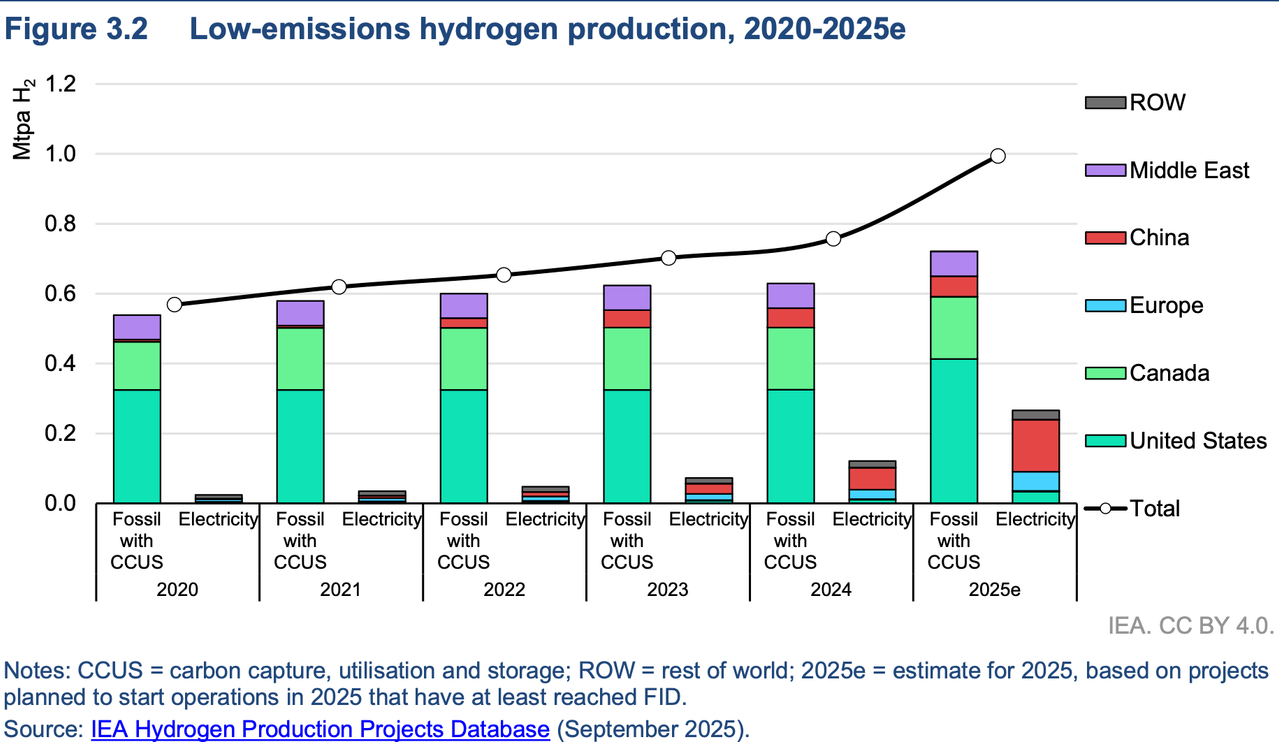
(22,500 posts)Production of “low-emissions hydrogen" is increasing, albeit slowly:
IEA (2025), Global Hydrogen Review 2025, IEA, Paris https://www.iea.org/reports/global-hydrogen-review-2025, Licence: CC BY 4.0
Nuclear power, while (relatively) clean (compared to fossil fuels) cannot do all things. It can be used to produce hydrogen, which has many uses.
https://www.iaea.org/topics/non-electric-applications/nuclear-hydrogen-production
The hydrogen economy is getting higher visibility and stronger political support in several parts of the world. In recent years the scope of the International Atomic Energy Agency (IAEA) program on non-electric applications of nuclear energy has been widened to include other more promising applications such as nuclear hydrogen production and high temperature process heat applications. Nuclear hydrogen production technologies have great potential and advantages over other sources that might be considered for a growing the hydrogen share in a future world energy economy. The selection of hydrogen technologies (to be coupled to nuclear power reactors) greatly depends on the type of the nuclear power plant itself. Some hydrogen production technologies, such as conventional electrolysis, require only electric power. Whereas others, such as thermochemical cycles, may require only process heat (which may be delivered at elevated temperature values) or hybrid technologies such as the high temperature steam electrolysis (HTSE) and hybrid thermochemical cycles, which require both heat and electricity.
…
OKIsItJustMe
(22,500 posts)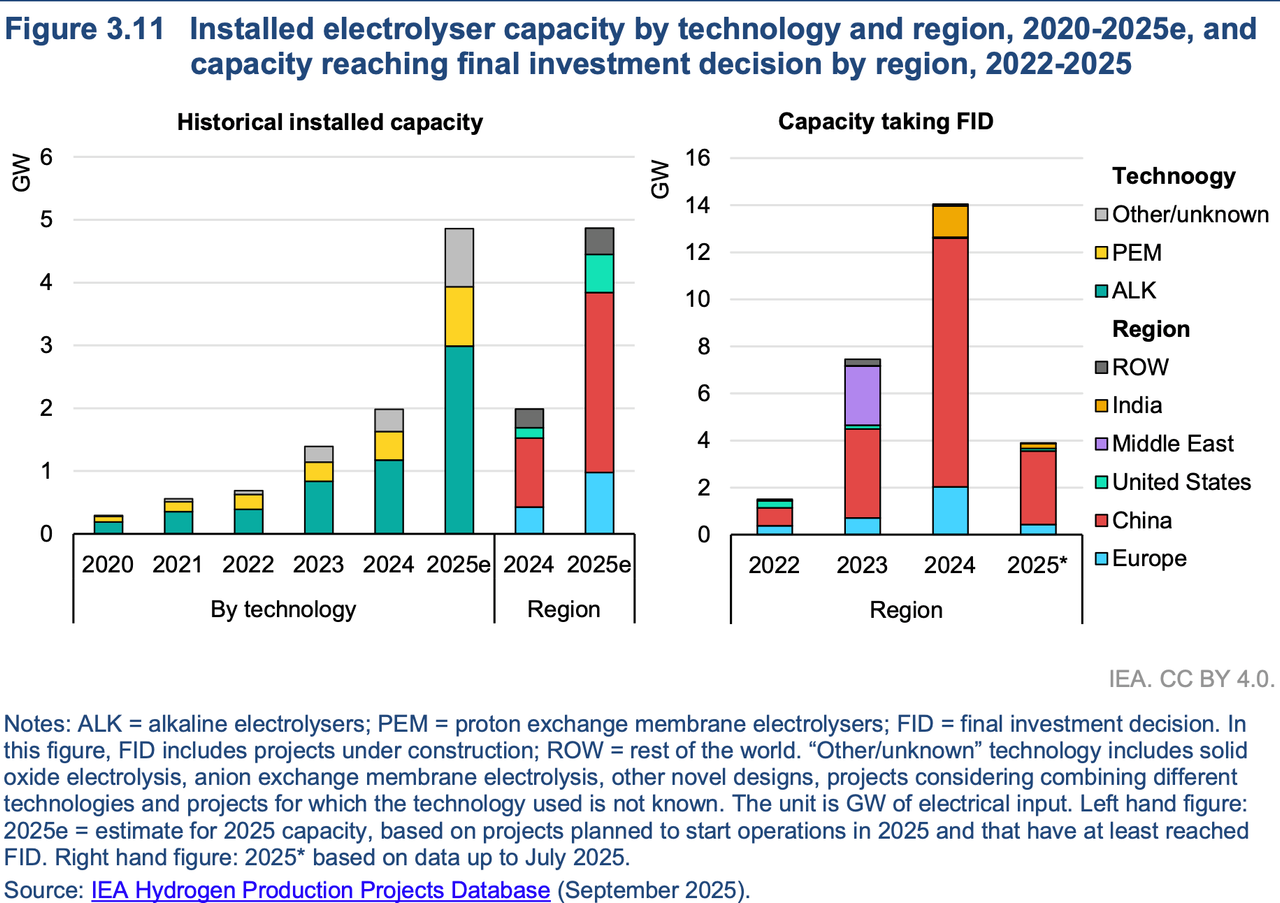
IEA (2025), Global Hydrogen Review 2025, IEA, Paris https://www.iea.org/reports/global-hydrogen-review-2025, Licence: CC BY 4.0
NNadir
(38,974 posts)Antinukes just love "percent talk."
They always have and always will, all the while not noticing that the world is burning.
If I have two dollars and I increase my holdings by 100%, I still will not be Jeff Bezos with tons of money to destroy once prominent newspapers.
Speaking of "percent talk" when did the people selling electrolyser "green hydrogen" find out that electricity is 100% produced without fossil fuel combustion?
They didn't find out?
Why is that?
Could it be that it's because electricity is overwhelmingly produced by combustion of dangerous fossil fuels with exergy destruction?
If anyone wants to really understand anything at all about hydrogen in order to have an intelligent opinion about the subject, as opposed to a hand waving wishful thinking nonsense opinion of the subject, one can find the relative exergy destruction comparing the SMR process with electrolysis.
I personally spent time doing this and have wrote about it, supplying a selection of references on the topic, in this space.
On this planet as of 2026, steam reforming of methane is actually cleaner than electrolysis as a means to make hydrogen, which is still a dirty process. This is a function of the laws of chemical physics which are not determined by opinion but rather are obtained by the analysis of experiment.
In "percent talk," hydrogen production is responsible for roughly 3% of carbon dioxide emissions.
One doesn't need access to the scientific literature to find this "percent talk" figure although one can find it there, It's available at the MIT climate portal.
Despite all the prattling about "green hydrogen" over the last half of a century, hydrogen remains what it always has been, a dirty, if essential, industrial product.
Have a nice day.
OKIsItJustMe
(22,500 posts)Since I do not adhere to every tenet of your religion, you identify me as a heretic (an "anti-nuke.”)
I am not “anti-nuke.” I would greatly prefer to see nuclear fusion, rather than nuclear fission. Until fusion reactors are ready to deploy, fission is what we have. (They are not rapidly deployed. Historically, they have run past deadlines and over budgets. [Still waiting on those Gen-IV reactors which were "just around the corner" back in 2000…])
New York State relies on a modest fleet of aging “Gen-II” reactors. While they are obsolete, we cannot afford to simply take them off-line. Unlike many “progressives” in New York, I’m in favor of the plan to deploy "Advanced Nuclear Energy” (which includes nuclear fusion.)
At the same time, I support the use of batteries, hydrogen and other forms of energy storage. Nuclear plants (as you know) are most efficient when running at 100%, providing “base load” to “the grid.” Electrical demand, is not constant. It would be stupid to attempt to build enough generating capacity to supply “peak load” when you can store energy at times of lower demand to be dispatched at times of higher demand. We’ve known this for decades. That’s why New York built the Blenheim–Gilboa Hydroelectric Power Station in 1973 and why we’re still using it today. Another approach for dispatchable power is natural gas “peaker plants."
Energy storage is also useful for making “renewables” more practical. I purchase solar power credits from a farm with batteries for dispatchable grid power. Battery technology has advanced significantly in the half century since “Blenheim–Gilboa” came on-line.
But there is much more to energy use than just the electrical grid. Obviously, we have vehicles. Passenger cars, buses, freight trucks, trains and even airplanes. None of these are especially well suited to nuclear power. Today, they are primarily powered by petroleum (it’s tough to beat the energy/volume ratio of liquid fuels.) Cars can be powered by batteries, for larger vehicles, hydrogen becomes more practical. Hydrogen can also be combined with other elements to produce heavier fuels, for higher energy/volume ratios. The massive freight ships plying our oceans might be well suited for nuclear power, just as aircraft carriers have been for decades, or they can burn “electrofuels” like “green ammonia” produced using “green hydrogen."
We also have isolated facilities which need reliable power (something solar panels and batteries can provide.) We figured this out decades ago as well. I remember the first time I saw a road sign with an attached solar panel. Small isolated villages can be powered in the same way.
Your "nothing but nukes" zealotry is no more rational than “no-nukes” zealotry.
NNadir
(38,974 posts)I've been attending lectures at the Princeton Plasma Physics Lab with lots and lots and lots and lots of zeal, so there's that.
It's this series: The Ronald E. Hatcher Science On Saturday Lecture Series
The talks can be viewed going back for many years using the archives although I'm not sure they go back the 15 years I've been attending these events. My son was in junior high school when I first took him there, and now he's finishing up his Ph.D in, um, nuclear engineering, specifically nuclear materials engineering.
(He's no rube.)
Every year there is at least one, sometimes three or four about the coming miracle of fusion energy discussed in the roughly 10 talks offered each winter there, although this year, somewhat unusually, there only seems to be one such lecture.
This year is the 75th anniversary of the Princeton Plasma physics lab, founded by Lyman Spitzer to develop fusion energy, beginning with the stellarator, parts of the original on display in the lobby of the Lyman Spitzer building.
In the lecture two weeks ago, Dr. Laura Berzak Hopkins gave us a wonderful overview of the 75th year, including the fact that it was founded in the Rabbit Hutch where the first stellarator was built.
Science On Saturday: Celebrating 75 Years of Powering Possibilities at PPPL
It was a very nice lecture. A self declared "balanced" person who thinks it's just fine to pretend to give a fuck about the collapse of the planetary atmosphere while waiting for nuclear fusion plants to be built in New York, being sure to acknowledge the fission advocates Kharecha and Hansen with ersatz admiration while doing so, might profit from watching the lecture when it comes up in the archives.
One of the new features of PPPL lectures was that Dr. Berzak Hopkins, who is the assistant director of the laboratory, was careful to not bad mouth fission, but rather to praise it as being clean and safe, at one point noting that the name of the lab she directs is not the Princeton Fusion Physics Laboratory, but rather is the Princeton Plasma Physics Laboratory.
I'm an atheist, but nonetheless all I can say is, "Bless her beating heart."
In this, developments in plasma physics, and in other areas, the lab is a success. But no, they do not have much beyond the faintest idea of how to transform fusion plasmas into exergy, nor they really know how to handle 14 MeV neutrons, an order of magnitude more energetic than fission neutrons.
(I have wonderful zealot chats with my son on this topic, high energy particles impinging on matter.)
In the 23 years I've been at DU, zealing away in zealot heaven while over in smuggle heaven, there are "I'm not an antinuke" antinukes handing out abstracts of papers, and complaining that people don't build nuclear reactors, although over 100 were built in this country by engineers largely relying on slide rules for day to day stuff, using computers less powerful than a modern cell phone, or even a wrist watch, while producing the lowest cost electricity price in the world.
Of course, now we learn that what has already happened is impossible.
By the way, in the 23 years I've been here listening to honest antinukes and "I'm not an antinuke" antinukes prattle on about so called "renewable energy" and how wonderful it is compared to nuclear - they don't give a rat's ass about fossil fuels - the concentration of the dangerous fossil fuel waste has risen, as of last week, the week beginning February 1, 2024, by 55.42 ppm to 428.10 ppm.
From my perspective, this says something about how realistic it is to lace every wilderness with wind turbines and solar cells.
And while acknowledging that the reactors exist, as is typical for all of the "I'm not an antinuke" antinukes who pass through here, year after year after year while the rate of the planetary atmospheric collapse accelerates, needs to share this little bit of cutting nonsense:
Could there be a reason that we lost 25 years of nuclear reactor development that has nothing to do with the skills of nuclear engineers?
How about, "nuclear energy is too expensive?"
As a zealot, I happen to think the collapse of the planetary atmosphere is very expensive, far more expensive than building thousands of fission reactors, but of course, I'm not a "fair and balanced" energy commentator. I'm a zealot.
How about, "Nobody knows what to do with nuclear waste" a mantra of people who can't actually identify anyone killed in this country by the controlled containment of used nuclear fuel, a chant by people who can't tell the difference between the neutron capture cross section of 99Tc and 237Np, "fair and balanced" types who argue that it's OK for millions of people to die each year from fossil fuel waste just so long as no one ever can be imagined to die of a leaked fission product ever?
By the way, since we're whining about predictions made in 2000 about Gen IV reactors, which did not, regrettably, have trillion dollar investments in solar and wind as predicted in 2000 replaced fossil fuels?
As for the obsession of "I'm not an antinuke" with things claimed thusly...
...they always want to tell me all about their fucking cars, the "I'm not an antinuke" antinukes around here.
In fact heat is as close to a primary energy source as one can get. If one were to seriously open a science book, and learn something about chemical physics, one might - although it takes some zealotry for considering energy issues in the primary scientific literature - understand that heat can drive chemical reactions, that basically, with hydrogen and carbon dioxide, one can manufacture any product found in petroleum, and in fact, once can make synthetic graphite.
You know, I'm an old man, facing the end of my life, considering the dying planet my generation left for all other to follow, and so I no longer give a flying fuck when people whine at me thinking I'm a rube.
I know who I am and what I'm about, and what I'm about has nothing to do with magical thinking.
By the way, a fucking natural gas "peaker" plant is an obscenity, and I'm really not all impressed with bourgeois types with poor educations carrying on about their fucking batteries and their "solar credits" as if they have a magic electron sorter on their electric meters. There isn't enough cobalt, or for that matter, enough fluorine to make batteries to cover months of Dunkleflaute in Germany, never mind the world.
Oh, and I was amused by the crocodile tears about trifluoroacetic acid. Just the other day I came across this paper:
Thermal Destruction Pathways and Kinetics for NTf2 and Longer-Chain Bis(perfluoroalkanesulfonyl)imides (Bis-FASIs) Jens Blotevogel, Wenchao Lu, and Anthony K. Rappé Environmental Science & Technology Letters 2024 11 (11), 1254-1259
From the first two sentences in the paper:
I added the bold and italics.
So then, what is fate of the trifluorosulfonic acid (triflate) ion, and whence the heat to decompose it flowing out of billions of batteries for when that so called "renewable energy" miracle that did not come and is not here saves the world, despite trillions of dollars thrown at it?
As it happens, I happen to know a great deal about persistent fluorinated alkyl species, with triflic acid being the simplest example of sulfonated species. I go through every issue of Environmental Science and Technology and every issue, like the current one linked, contains 5 to 10 papers on the subject. That may be a reason that I regard "green batteries" (along with "green hydrogen" ) as appalling doublespeak.
I may be a zealot, but I'll take a break from zealotry to state that I do have an opinion of what an "environmentalist" might be, and also what a "rube" might be.
From my perspective, anyone who knows so little about energy and energy science, specifically thermodynamics, as to think storing energy from unsustainable mass and land intensive junk is a good idea does not qualify for describing themselves as the former, but to my mind but, if only in my opinion, certainly qualifies for the latter.
Thank you for your kind one word opinion of me and my personality. I'll consider the source, with an appropriate level of amusement to be sure.
Have a nice hump day tomorrow waiting around for that fusion miracle and all those 14 MeV neutrons that are sure to save the world, this while ignoring that while we wait the world is burning now.
JFC.

thought crime
(1,848 posts)Your explanation is much better than anything I’ve posted and in “percent talk”, you are 100% correct. No matter what the Second Law of Thermodynamics has to say, it’s simply impractical to expect a society to switch completely to the exclusive use of direct electricity generated from nuclear energy with no other energy sources and no intermediate storage or conversion. The world just doesn't work that way.
OKIsItJustMe
(22,500 posts)Zealots are not swayed by reason.
thought crime
(1,848 posts)The researchers seem to be very aware of the emerging market for hydrogen and are targeting a solution to boost it. Eliminating the need for precious metal is a giant step forward.