Welcome to DU!
The truly grassroots left-of-center political community where regular people, not algorithms, drive the discussions and set the standards.
Join the community:
Create a free account
Support DU (and get rid of ads!):
Become a Star Member
Latest Breaking News
Editorials & Other Articles
General Discussion
The DU Lounge
All Forums
Issue Forums
Culture Forums
Alliance Forums
Region Forums
Support Forums
Help & Search
Cooking & Baking
Related: About this forum
Scusi! Marcella Hazan Is To Italian Cuisine, As Julia Child is to French. 🌞

Zuppa dei Poveri con la Rucola
ARUGULA AND POTATO SOUP
This is called a "poor man's soup" because its bulk comes
from potatoes and stale bread, and its flavor from arugola, often known
as rocket {nicola in Italian) . Arugola grew wild and free in the fields,
and the women of the poor used to gather an apronful of it in an hour.
Whatever else the Italian poor may have lacked, it was not good sense
about food. It is demonstrated here. Nothing could be simpler or much
better.The quantities of potato, bread, and water are to be taken as
suggestions. To me they are well balanced. But, if you want the soup
thicker, you can put in more bread and/or potatoes, and if you want it
thinner, a little less of those and a little more water.
For 4 persons
4 medium potatoes, peeled and Salt
diced (about 2 cups) 2 cups cut-up stale Italian
3 cups water or French bread
2 cups arugola leaves, Freshly ground black pepper
loosely packed V4 cup green, fruity olive oil
1. Put the potatoes and water into a pot, and bring to a boil.
2. Wash the arugola in numerous changes of cold water, until you
are sure it is completely free of sand.
3. After about 10 to 15 minutes, when the potatoes are halfway
cooked, put in the arugola and 2 large pinches of salt. Cover the pot.
4. Cook for 15 to 20 minutes at medium heat, then turn off the
heat. Put in the bread, and cover the pot. Let stand about 10 minutes.
5. Add a liberal grinding of pepper and the olive oil. Stir well,
then taste and correct for salt and pepper. Serve immediately.
SUGGESTIONS FOR SECOND COURSE: Follow this soup with a
meat course that shares its simple country character. Any pork dish
would be a good choice, such as Pork Chops,Grilled Marinated
Spareribs or Sausages with Red Cabbage.
*****************************************************************
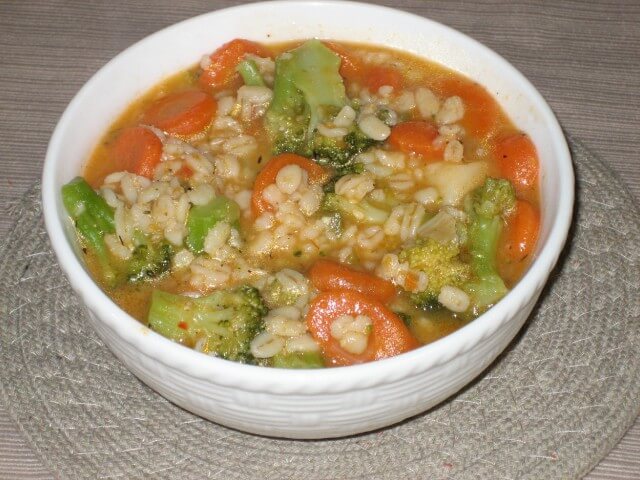
Minestrina di Broccoli e Manfrigul
BROCCOLI AND HOMEMADE BARLEY SOUP
MATHEMATICIANS sometimes use the word "elegant" to describe
the grace and felicity with which the elements of a mathematical
proposition connect. It may seem far-fetched to borrow the term and
apply it to this most humble soup. But I believe it fits. It is certainly
not elegant in the sense that it is fancy. It is elegant in the way the
different properties of its meager ingredients are explored, developed,
and exquisitely related. The procedure is simple, and nothing is wasted;
there are no loose ends.
The blanched broccoli is sauteed with garlic in olive oil. The florets
are kept aside, but the stalks are pureed together with their oil, and
added to the broth and the egg barley. The density of the soup is
thinned out with some of the water in which the broccoli was blanched.
When the pasta is done, the florets are dropped in, and the soup is
done. The tenderness of the florets, the firmness of the pasta, the
savoriness of the good broth enriched with oil, and the faintly garlicky
pureed stalks, all fall nimbly into place. If there is a better word than
"elegant" for how it is done, I can't think of it.
For 6 persons
A medium bunch of broccoli
2/3 cup **manfrigul, homemade egg barley , page 174
1/3 cup olive oil
1 teaspoon chopped garlic
2 cups homemade meat broth
1 tablespoon chopped parsley
Salt
Freshly grated Parmesan cheese for the table
egg barley
****Manfrigul, homemade Egg Barley
MANFRIGUL is homemade pasta chopped into small nuggets for
use in soups. Something very similar is made in Central Europe, and
I have seen it also in stores, where it is sold as egg barley. In Italy it
is native to the Romagna section of Emilia-Romagna.
The ingredients are the same simple ones that go into Romagna's
superlative homemade pasta—eggs and flour. Nothing else. Originally
it was produced by rubbing a ball of firm pasta dough against a
wooden grater. The graters have gone the way of many wonderful old
kitchen tools. People today do the job with a knife. One can even
use the food processor.
Once made, manfrigul can be stored in a cupboard in a glass jar,
and kept for months. It is marvelous in a vegetable soup or a bean
soup where you would use pasta or rice. And it is also good on its own,
in a homemade consomme, served with a little grated cheese. Its
distinguishing feature is a robust, inimitable chewiness that imparts
character and textural contrast to soup.
One may ask, why bother with making it at home when there are
so many kinds of soup pasta available at the grocery store? The
answer is that manfrigul is much better. And it doesn't take all that
much bother, even if you do not have the food processor.
Yield: About 1 cup manfrigul if chopped by hand
or 3/4 cup if done in the food processor
1 1/2 cups unbleached flour
2 eggs
1. Pour the flour onto a work surface and shape it into a mound.
Make a deep hollow in the center of the mound, and break into it the 2
eggs. Beat the eggs lightly with a fork. Bring the sides of the mound
together, and knead thoroughly for 8 to 10 minutes until you have a
firm, compact mass of dough. Shape the dough into a flattened ball
about 2 inches high.
NOTE: Although the kneading process can be done by the steel
blades of the food processor, it is recommended that you do it by
hand, as with other forms of pasta. Should you decide to use the
processor, knead the dough by hand afterward in any case, for at
least 1 minute.
2. Cut the ball of dough into the thinnest possible slices, and
spread them on a towel. Turn them from time to time. They must
dry enough to lose their stickiness, but not be so dry as to become
brittle. Depending on the temperature of the kitchen, it should take
about 20 to 30 minutes. Cut one of the slices after a while, to see if
it is ready. When the dough is no longer sticky, transfer it to a cutting
board, and dice it very fine with a sharp knife. The individual nuggets
should be no more than Vs inch thick.
NOTE: This chopping step can be done in the food processor, using
the steel blades. Turn the processor on and off several times, to assure
fairly even chopping. When done, part of the dough will have become
pulverized, and must be discarded. Empty the processor bowl into a
fine strainer, and shake the fine, pulverized dough away.
3. If you plan to store the manfrigul for future use, spread it on
a kitchen towel, and let it dry out thoroughly. It will take about 12
hours, so it would be practical to leave it out overnight. If you are
going to use the pasta the same day, this step is not required. When
cooking manfrigul, bear in mind that, in spite of its minute size, it is
rather tough and will take a little while to become tender.
********************************
(back to the soup)
1. Detach the broccoli florets from the stalks. Cut off about Vz
inch from the tough butt end of the stalks. Peel away the dark green
skin on the stalks and larger stems. Split the thickest stalks in two,
lengthwise. Rinse all the stalks and florets in cold water.
2. Bring about 3 quarts water to a boil. Add 2 tablespoons salt,
and put in the broccoli stalks. Two minutes after the water returns
to a boil, put in the florets. If they float, dunk them below the surface
from time to time, to keep them green. Cook 1 more minute after the
water again returns to a boil, then retrieve the broccoli with a colander
or slotted spoon. Do not discard the water.
3. Choose a saute pan large enough to accommodate later all the
stalks and florets in a single layer. Put in the oil and garlic, and turn
on the heat to medium high. Saute the garlic until it becomes colored
a light gold.
4. Add all the broccoli with a couple of large pinches of salt, turn
up the heat, and cook, stirring frequently, for 2 to 3 minutes.
5. Transfer the florets with a slotted spoon to a plate, and reserve for later.
6. Put the stalks, the oil from the pan, and 1 tablespoon of the
water in which they were blanched into the container of a blender,
and puree. If using the food processor, put in the stalks first, run
the steel blades for a moment, then add the oil and water, and finish
pureeing.
7. Put the pureed stalks and the broth into a soup pot, and bring
to a boil. Add the "barley." Stir and cook at a moderate boil until
the pasta is tender but firm. It should take about 10 minutes, or more
depending on the thickness and freshness of the pasta. The consistency
of the soup tends to become too dense as it cooks, so thin it out with
some of the water reserved after blanching the broccoli. Do not make
it too runny, however.
8. While the pasta is cooking, separate the floret clusters into
single bite-size pieces. As soon as the pasta is done, put in the florets
and the chopped parsley. Stir, and taste and correct for salt. Serve
promptly, with grated Parmesan cheese on the side.
**For a light supper, follow with **fritlata with pan-fried potatoes.
****
**Fritlata with pan-fried potatoes.

Frittata con le Palatine Fritte
OPEN-FACED OMELET WITH PAN-FRIED POTATOES
Here a simple and offbeat variation on the onion frittata
theme. The potatoes are diced into tiny cubes so that they are mostly
fine, crackling crust when they are browned. They are then combined
with sauteed onions for the frittata mix. It is an engaging pairing of
the tender and the crisp.
For 4 to 6 persons
1/3 cup vegetable oil
2 tablespoons butter
2 cups potatoes, peeled, rinsed, and diced into very fine (1/4 -inch) cubes
1 cup onion, sliced as fine as possible
6 large eggs
Salt
Freshly ground black pepper
1. Choose a skillet or saute pan large enough to accommodate all
the potatoes in a single layer, without overlapping. Put in the oil, and
turn on the heat to medium high.
2. When the oil is quite hot, put in the potatoes. Turn them at first
to coat them evenly with oil. Then spread them in an even layer, and
do not stir them except to check, after a little while, if they have formed
a nice brown crust on their underside. When they do, turn them and
cook until they have formed a golden brown crust all over. With a
slotted spoon or spatula, transfer the potatoes to a platter lined with
paper towels to drain.
3. Put the sliced onion in the same pan, containing still the same
oil in which the potatoes were cooked. Turn on the heat to medium,
add some salt, and saute the onions until they are tender and become
colored a rich gold. Transfer them to a dish, using a slotted spoon or
spatula to drain them well of oil.
4. Pour out the oil from the pan, and clean the pan thoroughly.
5. Break the eggs into a mixing bowl, and beat them lightly with a
fork. Add the potatoes, onions, salt, and a few grindings of pepper.
Mix well.
6. Melt the 2 tablespoons butter in the pan over medium heat. Do
not let the butter become colored. As soon as it begins to foam, pour
the contents of the bowl into the pan, spreading evenly with a fork.
Turn the heat down to very low. Finish cooking as directed in the
preceding recipe for frittata, step 7.
ADDITIONAL SERVING SUGGESTIONS: Like any frittata, this is an ideal
dish for a light lunch. It could also be chosen to precede one of the
tastier fish dishes, such as Sweet and Sour Tuna Steaks, Trapani Style.
It is very good eaten cold; you should give it a try next time you make
up a picnic basket.
**********************************************************************

Ziippa di Riso col Cavolo Stufato
RICE and SMOTHERED CABBAGE SOUP
SOUPS ARE where good leftovers go when they are reborn. This
one is the happy reincarnation of the Smothered Green Cabbage,
Venetian Style. Here we use the entire amount of cabbage produced
by that recipe because we are starting from scratch, and the
cabbage is so good one can never have too much of it. But, if
you were actually making the soup with only the leavings of that
recipe, you would fill it out the way a good Venetian cook does—with
a few smothered onions, some diced potatoes, a little extra rice.
Like risi e bisi, the Venetian rice and pea soup, this one is fairly thick,
but it is not a risotto. It should be runny enough to require a spoon.
A light homemade broth would be best here, but you can start it off,
if necessary, with bouillon dissolved in water, or diluted canned broth.
If you need additional liquid during the cooking, switch to water
because adding anything but homemade broth would make the flavor
too sharp.
For 4 to 6 persons
The **smothered cabbage produced with the recipe on
page 374 (It may be made 2 or 3 days ahead of time.)
3 cups homemade broth or 1 1/2 bouillon cubes
dissolved in 3 cups warm water or 1 cup canned beef
broth added to 2 cups water
2/3 cup rice, preferably Italian Arborio rice
2 tablespoons butter
1/3 cup freshly grated Parmesan cheese
Salt
Freshly ground black pepper
1. Put the cabbage and broth into a soup pot. Turn on the heat
to medium.
2. When the broth comes to a boil, add the rice. Cook uncovered,
at a slow boil, stirring from time to time. The soup is ready when the
rice is done. It should be cooked al dente, tender but firm to the bite,
about 15 to 20 minutes. If you find that the soup is becoming too thick
while the rice is cooking, add more homemade broth, or water, as
required. At the end, the consistency of the soup should be rather
dense.
3. When the rice is done, add the butter and the grated cheese,
and stir well. Taste, and add what salt and pepper may be needed.
Serve medium hot, giving the soup just a few minutes' rest after it
finishes cooking.
*********************************************************************

Cavolo Stufato alia Veneziana
SMOTHERED GREEN CABBAGE, VENETIAN STYLE
THE PEOPLE of the Veneto have found many tasty things to do
with cabbage, and this is one of them. The finely shredded cabbage is
cooked very slowly in a covered pot in the vapors of its own escaping
moisture, in some olive oil, and with a tiny bit of vinegar. No other
liquid is necessary. The Venetian term for this method is sofegao,
which is exactly translated by "smothered." The cabbage becomes very
tender, almost dissolving, with that satisfying sweetness of slow-cooked
cabbage, here faintly punctuated by the light, sour accent of vinegar.
For 4 to 6 persons
2 pounds smooth green cabbage
1/2 cup chopped onion
1/2 cup olive oil 1 tablespoon wine vinegar
1 tablespoon chopped garlic
Salt
Freshly ground black pepper
1. Remove and discard the first few outer leaves of the cabbage.
Shred the cabbage very fine. (The food processor does this perfectly
and in no time.)
2. Put the onion and olive oil into a deep saute pan, and turn on
the heat to medium. Saute the onion until it becomes colored a deep
gold, then add the garlic.
3. Saute the garlic for a minute or two, then add all the shredded
cabbage. Stir and turn the cabbage for several minutes until it is all
wilted.
4. Add salt, a few grindings of pepper, and the vinegar. Cover the
pan, and turn the heat down to minimum.
5. Cook for at least 1 1/2 hours, or until very tender. Turn it every
once in a while. Taste and correct for salt and pepper. Some like it
served piping hot. I prefer to let it rest just a few minutes after it's
done.
SERVING SUGGESTIONS: Very good with pork and with grilled
meats. It would be excellent with thick, juicy hamburgers. Try it with
Skewered Veal and Sausage with Sage and White Wine (page 276) , or
with Pan-fried Sausages with Red Wine and Dried Wild Mush
SUGGESTIONS FOR SECOND COURSE: A great variety of meat
courses can follow this, but avoid those that have too much onion.
Onion is sweet and would be a monotonous echo of the sweetness of
the cabbage.
Suggestions: Stuffed Beef Braciole, Skewered
Veal and Sausage with Sage and White Wine , Pork Chops
Braised with Marsala and Red Wine , Drunk Roast Pork, Pan-roasted
Chicken with Lemon Juice.
All the above from "More Classic Italian Cooking" by Marcella Hazan
https://www.goodreads.com/book/show/21200.More_Classic_Italian_Cooking
The very best Italian Cooking you've ever tasted!!

