Welcome to DU!
The truly grassroots left-of-center political community where regular people, not algorithms, drive the discussions and set the standards.
Join the community:
Create a free account
Support DU (and get rid of ads!):
Become a Star Member
Latest Breaking News
Editorials & Other Articles
General Discussion
The DU Lounge
All Forums
Issue Forums
Culture Forums
Alliance Forums
Region Forums
Support Forums
Help & Search
General Discussion
Showing Original Post only (View all)
Samuel Alito Had No Answers For Ketanji Brown Jackson's Latest Dissent [View all]
https://ballsandstrikes.org/scotus/samuel-alito-ketanji-brown-jackson-callais-dissent-no-answers/Jay Willis
The more transparently political the Court's work becomes, the more fiercely the conservative justices insist that there is nothing political about the Court's work.
Much leading and trailing material snipped. Please read the whole article for completeness.
. . .
Although Jackson did not spell it all the way out in her opinion, the implication is pretty clear: Then, Alito disapproved of judicial intervention when it would have harmed Republicans in Texas; now, he is greenlighting judicial intervention when it will harm Democrats in Louisiana. Then, Alito argued that under Purcell, a court should not interfere with a primary election scheduled to take place in three months; now, he is arguing that Purcell poses no obstacle to a court interfering with a primary election that is already in progress.
Jackson's dissent prompted Alito to write a concurring opinion that is more or less an angry blog post about how much Jackson had hurt his feelings. Joined by Justices Clarence Thomas and Neil Gorsuch, Alito gestures briefly at the fact that the 32-day waiting period is a "default" rule that the Court can set aside when circumstances warrant. But his real goal is to air out his grievances with Jackson, whose opinion, he says, "levels charges that cannot go unanswered." At various points, Alito refers to the thrust of her dissent--the simple observation that the Republican justices are selectively applying rules and precedents in ways that help Republican politicians win elections--as lacking "restraint," and as "groundless," "utterly irresponsible," and "baseless and insulting."
It is of course not new for Supreme Court justices to get snippy with each other in dueling opinions. But what is notable about Alito's rejoinder to Jackson--especially given his stated purpose of writing separately so as not to let her "charges" go "unanswered"--is how bereft it is of anything that even has the cadence of legal analysis. Perhaps the most telling passage comes in the second-to-last paragraph, when Alito asks, rhetorically, what "principle" Jackson believes the Court to have violated. Then, he offers two sarcastic possibilities: the "principle" that the Court should never shorten the 32-day period, and the "principle" that the Court "should never take any action that might unjustifiably be criticized as partisan."
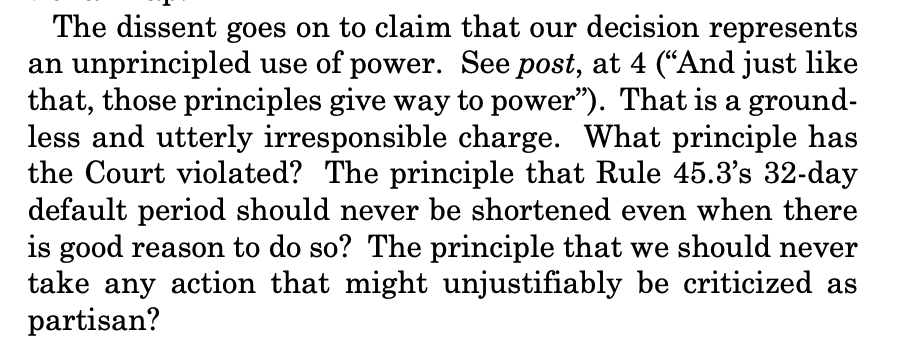
This is a weird question for him to frame as a gotcha, because, again, there is a real answer: In her opinion, Jackson details how the Court's choice in this case conflicts with its choices in Rucho, Purcell, and Abbott. But Alito does not respond to Jackson's point about Rucho, or assert that she is wrong about Purcell, or explain how his actions in Abbott and Callais can be reconciled. In fact, his opinion does not mention Purcell at all; he simply asserts that by having the temerity to disagree with him in public, Jackson is being very rude to him.
. . .
Although Jackson did not spell it all the way out in her opinion, the implication is pretty clear: Then, Alito disapproved of judicial intervention when it would have harmed Republicans in Texas; now, he is greenlighting judicial intervention when it will harm Democrats in Louisiana. Then, Alito argued that under Purcell, a court should not interfere with a primary election scheduled to take place in three months; now, he is arguing that Purcell poses no obstacle to a court interfering with a primary election that is already in progress.
"The Court unshackles itself from both constraints today and dives into the fray," Jackson concluded. "And just like that, those principles give way to power."
Jackson's dissent prompted Alito to write a concurring opinion that is more or less an angry blog post about how much Jackson had hurt his feelings. Joined by Justices Clarence Thomas and Neil Gorsuch, Alito gestures briefly at the fact that the 32-day waiting period is a "default" rule that the Court can set aside when circumstances warrant. But his real goal is to air out his grievances with Jackson, whose opinion, he says, "levels charges that cannot go unanswered." At various points, Alito refers to the thrust of her dissent--the simple observation that the Republican justices are selectively applying rules and precedents in ways that help Republican politicians win elections--as lacking "restraint," and as "groundless," "utterly irresponsible," and "baseless and insulting."
It is of course not new for Supreme Court justices to get snippy with each other in dueling opinions. But what is notable about Alito's rejoinder to Jackson--especially given his stated purpose of writing separately so as not to let her "charges" go "unanswered"--is how bereft it is of anything that even has the cadence of legal analysis. Perhaps the most telling passage comes in the second-to-last paragraph, when Alito asks, rhetorically, what "principle" Jackson believes the Court to have violated. Then, he offers two sarcastic possibilities: the "principle" that the Court should never shorten the 32-day period, and the "principle" that the Court "should never take any action that might unjustifiably be criticized as partisan."
This is a weird question for him to frame as a gotcha, because, again, there is a real answer: In her opinion, Jackson details how the Court's choice in this case conflicts with its choices in Rucho, Purcell, and Abbott. But Alito does not respond to Jackson's point about Rucho, or assert that she is wrong about Purcell, or explain how his actions in Abbott and Callais can be reconciled. In fact, his opinion does not mention Purcell at all; he simply asserts that by having the temerity to disagree with him in public, Jackson is being very rude to him.
. . .
9 replies
 = new reply since forum marked as read
Highlight:
NoneDon't highlight anything
5 newestHighlight 5 most recent replies
= new reply since forum marked as read
Highlight:
NoneDon't highlight anything
5 newestHighlight 5 most recent replies
= new reply since forum marked as read
Highlight:
NoneDon't highlight anything
5 newestHighlight 5 most recent replies
Samuel Alito Had No Answers For Ketanji Brown Jackson's Latest Dissent [View all]
erronis
16 hrs ago
OP
Ketanji Brown Jackson is not afraid of the pompous white bros (and their lil sister and Clarence.)
erronis
15 hrs ago
#3
"neither the facts nor the law are on his side. All he can do is pound the table and yell about it."
mountain grammy
13 hrs ago
#7
Deadline Legal Blog-Louisiana map order highlights splits within the court's GOP and Democratic wings
LetMyPeopleVote
9 hrs ago
#8