San Andreas fault reaches highest stress level in 1,000 years [View all]
https://mauinow.com/2026/06/15/san-andreas-fault-reaches-highest-stress-level-in-1000-years/
Buckle up.
Recent research led by University of Hawai‘i at Mānoa scientists found tectonic stress along the San Andreas and San Jacinto fault systems in Southern California has reached — in some places exceeded — the highest levels seen in the past 1,000 years.
The study, recently published in the
Journal of Geophysical Research: Solid Earth, has direct implications for seismic hazard assessments in one of the most densely populated and infrastructure-critical corridors in the United States.
“Our results show that stress levels on multiple fault segments are now at or above the highest values seen in the past millennium and that the region may be capable of a large through-going rupture involving both fault systems,” said lead author Liliane Burkhard in a press release.
Burkhard is a research affiliate at Hawai‘i Institute of Geophysics and Planetology in University of Hawai‘i at Mānoa School of Ocean and Earth Science and Technology.
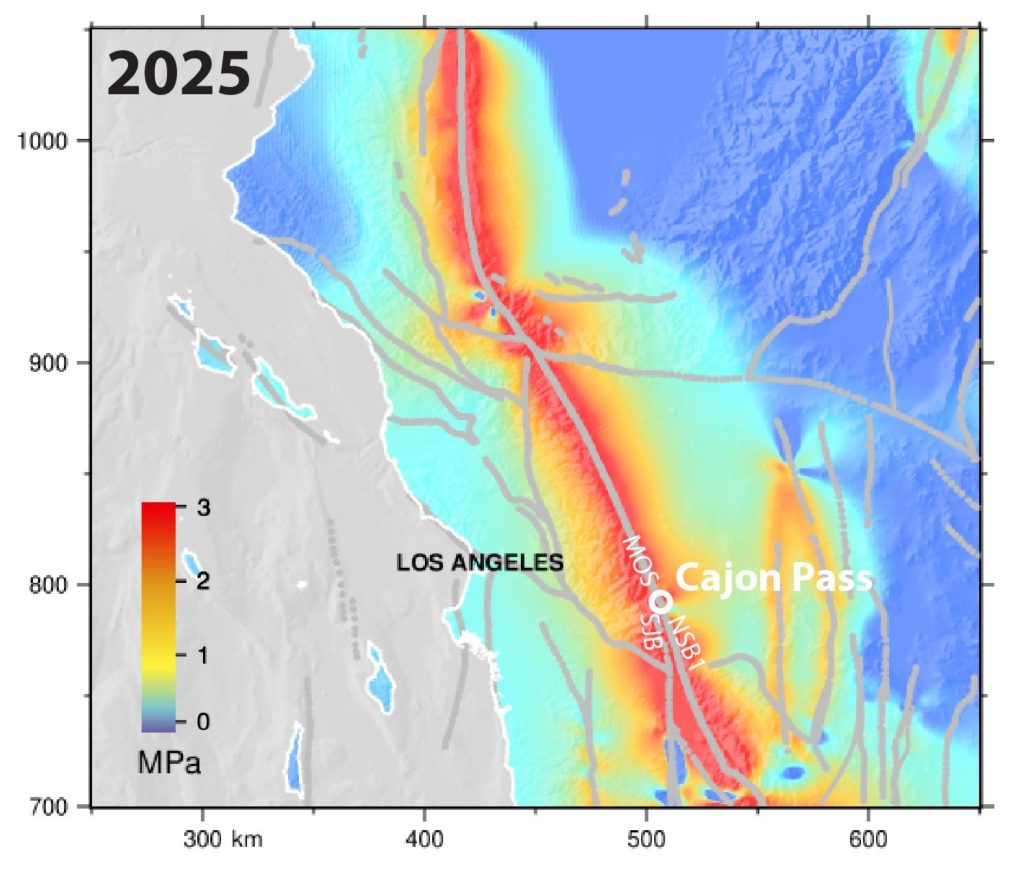
Report is open access, with pdf download available.
https://agupubs.onlinelibrary.wiley.com/doi/full/10.1029/2025JB033213
Plain Language Summary
Southern California's San Andreas and San Jacinto faults have not produced a major earthquake near Los Angeles in over a century. During that time, tectonic stress has continued to build along these faults, increasing the likelihood of a large future rupture. One key area of concern is Cajon Pass, where the two fault systems meet and could potentially rupture together. To investigate this, we used computer simulations of the last 1000 years of large earthquake activity to estimate how stress builds up on fault segments and affects neighboring segments over time. The model shows that stress has now reached high levels across the region and that the two fault systems may interact when their stress levels become similar. This suggests that Cajon Pass could act as an “earthquake gate” which sometimes blocks and other times allows large ruptures to propagate between faults. These results improve our understanding of earthquake interactions in Southern California and help refine regional hazard assessments.

 = new reply since forum marked as read